Miniature Painting
What is miniature painting?
Miniature painting is a style of small, highly detailed painting made by hand with very fine brushes. Miniatures were first made to illustrate books and manuscripts, and today they are also painted on paper, wood, bone, metal and other surfaces, including boxes, frames, plates, pen cases and game boards.
A miniature is recognized by its bright, pure colors, its delicate lines and its rich detail. Scenes often show gardens, landscapes, people, animals and stories, framed by decorative borders of flowers and arabesque patterns.
The word "miniature" refers to the fine scale of the detail rather than only to the size of the work. A miniature can be a few centimeters wide or cover a whole page, but in every case the detail is painted with great care.

Materials and tools
Miniature artists use simple tools, but they need a very steady hand and good eyesight:
- Very fine brushes, some with only a few hairs, for the smallest details.
- Paints made from mineral and plant pigments, mixed with a binder such as gum, or modern artist paints with similar qualities.
- Gold and silver, applied as paint or leaf, for highlights, borders and backgrounds.
- A smooth, prepared surface: polished paper, or wood, bone or metal that has been sanded and primed.
- A magnifying glass, which many artists use for the finest work.
- Varnish, used to protect paintings on objects such as boxes and boards.
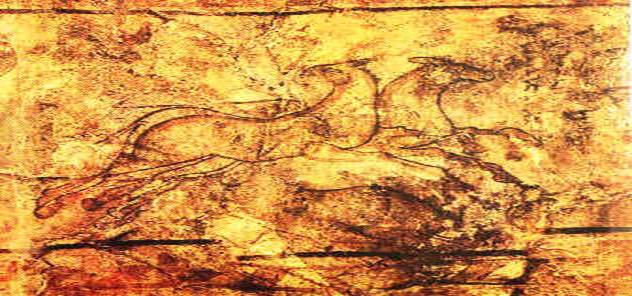
How a miniature is painted
Preparing the surface. Paper is smoothed and polished so that the paint flows evenly. Wood and bone are sanded and primed, so that the surface is smooth and takes the paint well.
Drawing. The artist first draws the composition in light, fine lines. In many miniatures, the drawing is planned carefully so that figures, buildings and plants fit together in a balanced way.
Laying in color. The main areas are filled with flat layers of color. Each layer must dry before the next is added.
Adding detail. Detail is added step by step: faces, hands, clothing, leaves, flowers and the small patterns of carpets, tiles and fabrics. Many artists build up color and shading with tiny dots and fine strokes, which gives soft modeling and depth.
Outlines and gold. The artist then adds the final outlines, which make the shapes crisp, and applies gold details and highlights.
Borders and finishing. Finally, the decorative border is painted, often with flowers, scrolls and gold lines. On objects such as boxes and boards, the finished painting is protected with a clear varnish.
A small, detailed miniature can take weeks to complete.
Features of a miniature
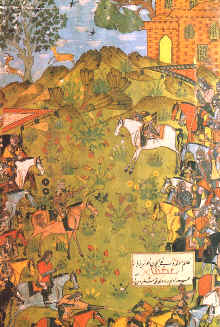
Miniatures follow their own visual rules. Instead of a single point of view, scenes are often shown from several angles at once, so the viewer can see inside buildings and across gardens at the same time. Colors are clear and bright rather than darkened by heavy shadows, and every part of the picture, from the sky to the ground, is filled with detail.
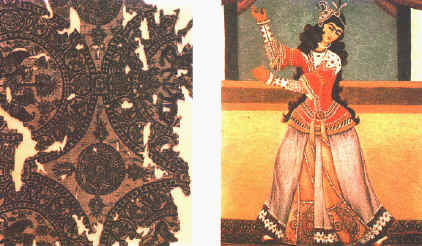
Figures are usually graceful and slender, and their clothing is painted with fine patterns. Nature plays a large role: flowering trees, birds, streams and rocks appear in many scenes, painted with the same care as the people.

Miniatures on objects
Miniature painting is often combined with other crafts. Backgammon and chess boards may have painted panels framed by inlay; boxes and pen cases may be painted on their lids and sides; frames and plates may carry a central painted scene. On these objects, the painting is protected with varnish, which makes it more resistant to handling.
How to choose a miniature
These points help you judge a handmade miniature:
- Look closely, ideally with a magnifier. Hand painting shows fine brushstrokes and slight variations; a print shows a regular dot pattern.
- Check the faces, hands and small details. Fine, clear detail is a sign of a skilled artist.
- Look at the colors: they should be clean and even, without smudges or patches.
- Look at the borders and gold work, which should be neat and well finished.
- Check the surface: on objects, the varnish should be smooth and clear, without bubbles or cloudy areas.
- Ask whether the work is signed. Many artists sign their miniatures in a small corner.
Caring for a miniature
Miniature paintings are delicate:
- Keep them away from direct sunlight, which can fade the colors over time.
- Protect paintings on paper with a frame and glass, and keep them in a dry place. A mat between the glass and the painting keeps the surface from touching the glass.
- Wipe painted objects gently with a soft, dry cloth. Do not use water or cleaners on the painted surface.
- Avoid sudden changes of temperature and humidity, which can affect paper, wood and bone.
- Handle paintings on paper by the edges, with clean, dry hands.
Themes in miniature painting
Miniatures often illustrate poems, stories and scenes from everyday life. Common themes include gardens in bloom, hunting and riding scenes, musicians and gatherings, lovers in a garden, and animals and birds. Some miniatures are purely decorative, showing flowers, birds and patterns without a story.
Borders are an important part of the art. A painting may be surrounded by several bands of decoration, from fine gold lines to wide borders of flowers and leaves. In some works, the border is as detailed as the central scene.

Original painting, copy or print?
Many miniatures today are inspired by older works, and artists often paint their own versions of well-known compositions. A hand-painted copy is still an original painting, because every line and color is painted by hand. A print, by contrast, is a mechanical reproduction.
If you are buying a miniature on paper, ask whether it is hand-painted and whether it is signed. If it is painted on an object, such as a box or a board, look closely at the edges of the painted areas, where brushwork is easiest to see.
Displaying a miniature
Because miniatures are small and detailed, they are best displayed where they can be seen up close: on a desk, beside a reading chair, in a hallway at eye level, or on a shelf. Soft, indirect light shows the colors and the gold well, while strong spotlights and direct sun should be avoided.
A miniature on paper looks good in a simple frame with a wide mat, which gives the painting space and draws the eye to its detail. Painted boxes, plates and boards can be placed on stands or tables, where they can also be picked up and looked at closely.
If you have several miniatures, grouping them together on one wall or shelf creates a small gallery, and it invites guests to stop and look at each one.
Whatever you choose, give the painting a calm place where it can be enjoyed slowly.
A window into a story
Each miniature invites the viewer to look closely and slowly. The longer you look, the more details you find: a bird in a tree, a pattern on a sleeve, a small flower at the edge of a path. This is what makes a handmade miniature a piece to enjoy for many years.